
Disclaimer: The information shared here is based on professional experience and is intended for general guidance. It is not specific marketing advice. Each business requires its own strategy.
How to Repurpose Content for AI Search, LinkedIn, and YouTube
Ahrefs studied 75,000 brands and found that branded web mentions, being discussed on other sites, correlate with AI visibility at 0.66 to 0.71 across ChatGPT, AI Mode, and AI Overviews, well above Domain Rating (0.266 to 0.326) and far above total site page count (about 0.194). Backlinks correlate weakly too, though Ahrefs doesn't publish an exact figure for that factor on its own. YouTube mentions in a video's title, transcript, or description correlate highest of all, about 0.737.
Ahrefs is explicit that correlation isn't causation: these are patterns, that improving one metric causes AI visibility to rise. Semrush separately studied 89,000 LinkedIn URLs cited across ChatGPT Search, Google AI Mode, and Perplexity and found that cited content is more commonly associated with frequent, original publishing than with viral engagement.
Read together, the data points toward a strategy: get discussed and mentioned across more places your audience and AI systems already look, rather than publish more pages on your own site alone. Here's a working definition, a way to decide what's worth repurposing, and a process for doing it.
Key Takeaways
- Branded web mentions correlate with AI visibility at 0.66 to 0.71, the strongest factor Ahrefs published an exact number for, well above Domain Rating (0.266 to 0.326) and page count (about 0.194). Backlinks correlate weakly too, though Ahrefs doesn't publish an exact figure for that factor alone.
- Ahrefs states directly that these are correlations, not proof that changing one factor causes AI visibility to rise.
- YouTube mentions correlate around 0.737, counted when a brand name appears in a video's title, transcript, or description, any one of the three.
- Cited LinkedIn content is more commonly associated with frequent, original publishing than with viral engagement, based on Semrush's study of already-cited posts.
- A topic is worth repurposing when it answers a real question, contains original analysis or data, and can be split into narrower questions each platform version can answer on its own. Repurposing a weak article just distributes weak content.
A Working Definition for Content Repurposing
Content repurposing for AI search is the practice of adapting one evidence-backed idea into independently useful formats across crawlable platforms, with each version built for that platform's audience and retrieval behavior. That's the working definition used in this article, not a claim that it's an established industry term.
Not Every Topic Is Worth Repurposing
A topic qualifies for repurposing when it meets three conditions. It answers a question the intended audience is already asking. It contains original experience, analysis, data, or a defensible interpretation of authoritative research. And it can be divided into narrower questions that each platform version can answer independently.
Repurposing a weak or generic article doesn't fix it. It distributes the same weak, generic content into more places. More formats don't create value that wasn't in the source material to begin with.
A Helpful Process for Repurposing One Piece of Content
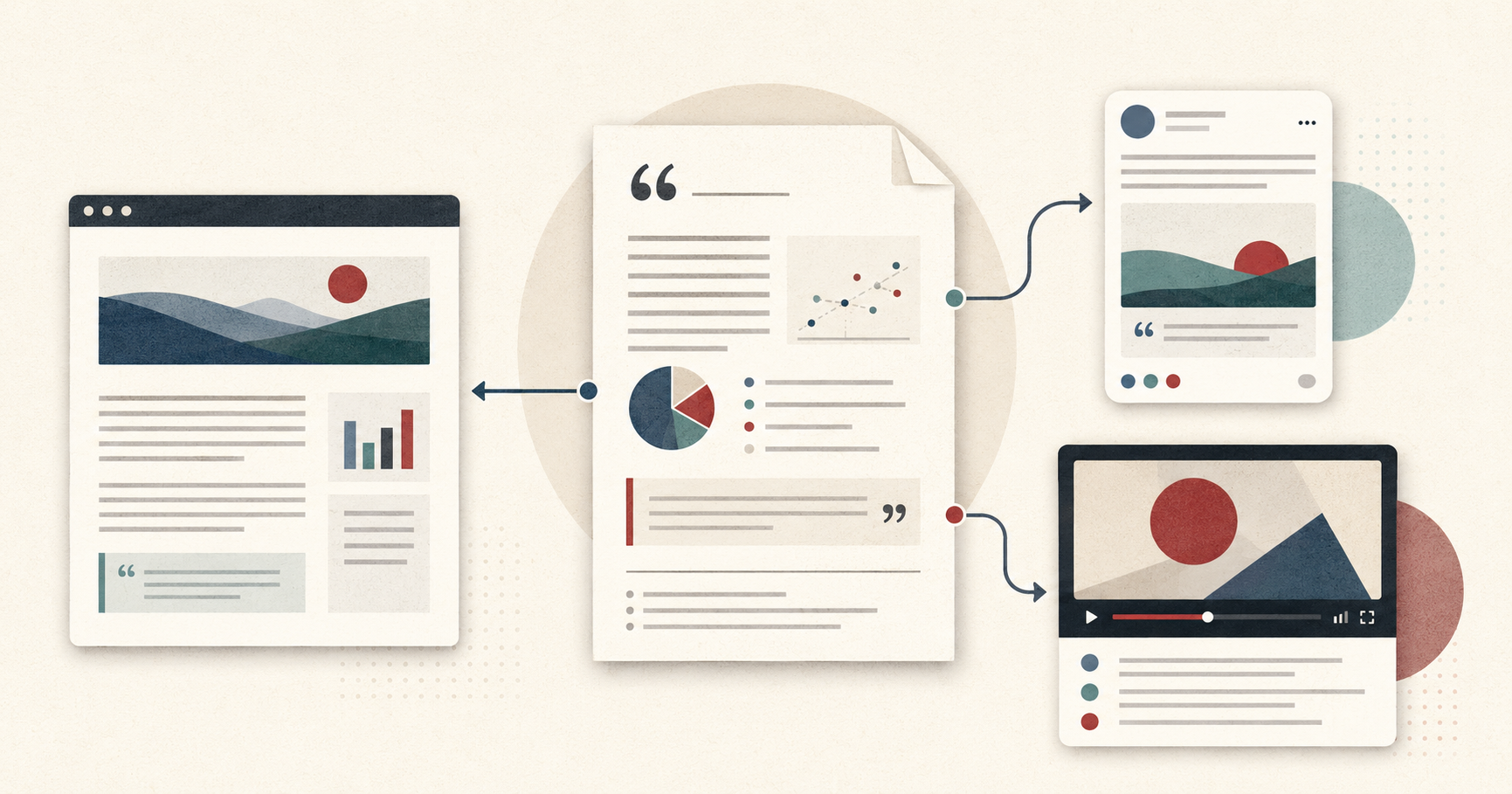
Website article. Answers the complete question: the full process this piece walks through. Holds the entire data set, the working definition, the three-part test, the sourcing, and the methodology notes. This is the version every other version points back to, and the only one built to carry it all.
LinkedIn article. Answers one narrower question pulled from the website piece, treated as a complete argument on its own, not a summary of the whole website article. Takes one finding or one section's worth of the data and gives it full treatment. Refers back to the website article once, near the end, as further reading for the broader process. Worth tracking whether it gets read or cited independently of the website piece.
LinkedIn feed post. Answers one fact or one finding, in a few sentences. Takes a single number, chart, or line from either longer piece and adds little beyond framing; its job is to surface one fact cleanly and point to both longer pieces. Worth tracking click-through to the linked articles.
YouTube video. Answers a business-owner-level question: what these findings mean for a content plan, at a depth a Short can't hold. Takes the practical implications of the Ahrefs and Semrush data and adds a spoken explanation and a point of view the written pieces can't offer.
The description links to the website article. Ahrefs counts a mention when the brand name appears in the video's title, transcript, or description; any one of the three qualifies for the correlation the study measured. Including the brand name in all three is a reasonable practice recommended here, not something the study requires. Worth tracking referral clicks from the description and whether the video itself starts appearing in AI answers.
YouTube Short. Answers one narrow, single-idea question in under a minute. Takes one distinction from the article, for instance, the difference between publishing more and getting discussed more. Refers to the full video or website article in the caption. Worth tracking completion rate and whether it sends traffic to the longer pieces.
| Platform | Question the asset answers | Recommended format | What must be unique | Discovery or visibility signal to track |
|---|---|---|---|---|
| Website article | The complete process for repurposing one piece of content across AI search, LinkedIn, and YouTube | Long-form article with data, sourcing, and a full argument | Holds the entire evidence base and methodology notes no other version carries | Page indexing; brand appearing in direct AI answers to this question |
| LinkedIn article | One narrower question pulled from the website piece | 500 to 2,000-word standalone article | A complete argument on its own, not a summary of the website piece | Independent reads or citations of the article itself |
| LinkedIn feed post | One fact or finding, stated in a few sentences | Short native post with a link | One number or line stated cleanly, no supporting argument needed | Click-through to the linked article or website page |
| YouTube video | What the findings mean for a business's content plan | Several-minute spoken explanation | A point of view delivered in a real voice, not a script read from the article | Brand name in the video's title, transcript, or description; watch time; referral clicks |
| YouTube Short | One narrow distinction, explained in under a minute | Under-60-second single-idea video | One idea, isolated from the rest of the argument | Completion rate; traffic to the longer video or article |
Republishing copies content; repurposing creates independently useful sources. Posting the same paragraph in five places doesn't add anything new for an AI system or a reader to find, it just adds volume.
For example, I wrote a sister LinkedIn article to this piece. It works because its more than shorter version of this piece, it's a complete argument about one narrower question. That's the difference between a repurposing plan that works and one that just multiplies the same content.
What Ahrefs Found About Getting Mentioned in AI Search
Ahrefs analyzed millions of AI responses across ChatGPT, AI Mode, and AI Overviews (Ahrefs, Top Brand Visibility Factors in ChatGPT, AI Mode, and AI Overviews, published 12 December 2025), filtered to domains with a Domain Rating above 40 and keywords with at least 800 monthly searches. Findings shouldn't be read as representative of every small or local business outside that filter.
| Factor | Correlation with AI visibility (Spearman) |
|---|---|
| YouTube mentions (title, transcript, or description) | ~0.737 |
| Branded web mentions | 0.656–0.709 (ChatGPT 0.664, AI Mode 0.709, AI Overviews 0.656) |
| YouTube mention impressions | ~0.717 |
| Domain Rating | 0.266–0.326 (ChatGPT 0.266, AI Mode 0.285, AI Overviews 0.326) |
| Backlinks | Very weak; Ahrefs doesn't publish an exact figure for this factor alone |
| Total site page count | ~0.194 |
Ahrefs states the limit directly: "correlation isn't causation… that doesn't mean improving these metrics will automatically boost your AI visibility." The study also measures whether a brand gets mentioned in an AI response, not necessarily whether that mention carries a link; it doesn't clearly separate a named mention from a linked citation. Treat the table as a map of where AI systems already find brands discussed, not a formula.
Two findings matter most. Branded web mentions correlate at 0.656 to 0.709, far above Domain Rating and well above backlinks' qualitative "very weak" rating. YouTube mentions correlate highest of all, about 0.737. Publishing more pages on your own site correlates the least of anything measured, about 0.194.
What Makes LinkedIn Content Get Cited by AI, According to Semrush
Semrush studied 89,000 LinkedIn URLs already cited across ChatGPT Search, Google AI Mode, and Perplexity (Semrush, We Analyzed 89K LinkedIn URLs Cited in AI Search, published 10 March 2026). Among that cited content, LinkedIn articles between 500 and 2,000 words accounted for 50 to 66% of citations, short feed posts accounted for 15 to 28%, and about 75% of cited authors had posted five or more times in the prior four weeks, with most cited posts showing modest engagement rather than viral reach. The study reports these as combined figures across all three platforms rather than broken out individually.
Semrush explains that frequent posting creates more opportunities for an AI system to find something worth citing, not that frequency itself is a ranking signal. Read narrowly: cited LinkedIn content is more commonly associated with frequent, original publishing than with viral engagement.
What Google's Spam Policy Says About Repurposing Content
Google's spam policies name "attempting to manipulate generative AI responses in Google Search" as a violation, and define scaled content abuse as producing many pages, including AI-generated pages, "for the primary purpose of manipulating search rankings and not helping users" (Google, Spam Policies for Google Web Search).
Repurposing, done right, adapts one useful idea into different formats for different audiences. It isn't the same as multiplying near-identical pages or posts to game a system, and Google's policy draws that line directly.
Do Backlinks Help You Get Cited by AI?
Backlinks have a weak association with AI visibility in the Ahrefs study. The research does not prove that acquiring a backlink increases the likelihood of an AI citation. Branded web mentions and YouTube mentions had much stronger correlations.
Does Publishing More Content Increase AI Citations?
Ahrefs found almost no relationship between total site page count and brand visibility in AI responses. Its page-count correlation was about 0.194. The study does not support publishing more pages solely to increase AI visibility. Bill Gates called it "Content is King" in 1996. These days, "More Content, More Problems" (that's mine) is closer to the truth.
Can an Agency Promise AI Citations?
No, and it's worth being skeptical of anyone who says otherwise. AI search algorithms are still evolving, the same way traditional SEO algorithms have shifted for two decades, and a fixed outcome isn't something a moving system supports.
Try This With One of Your Own Posts
Take a high-performing blog post from your own site. Build a LinkedIn article from one piece of its argument, pull a chart or a single finding for a feed post, and build a YouTube version with a clear title, a spoken brand mention, and an accurate transcript.
For the fundamentals of how AI tools read a website in the first place, see how businesses show up in ChatGPT and AI search results and why AI can't understand most business websites. For SEO and AI search visibility work or AI strategy and consulting, start with what's already working.
KELLY BIGGS
About the Author
Kelly is a Marketing Executive and Principal Consultant at WSI. Kelly has over 20 years of sale and marketing experience. She works with client to employ powerful digital marketing strategies and often writes about SEO, website optimization, and social media.
The Best Digital Marketing Insight and Advice
Subscribe Blog
For information on our privacy practices and commitment to protecting your privacy, check out our Privacy Policy and Cookie Policy.
Don't stop the learning now!